Working near the Temple Mount, head archaeologist Eilat Mazar uncovered the 10th century B.C.E inscription, engraved on a large pithos, a necklace ceramic jar, along with six others at the Ophel excavation site.
The inscription is written in the Canaanite language, a Biblical people who lived in the present-day Israel, and is the only of its kind to be found in Israel. The artifact predates the previously oldest inscription found in the area by 250 years and predates the Biblical Israelites' rule.
Saturday, July 13, 2013
BIBLE NEWS: Ancient alphabetical inscription discovered in Jerusalem
An ancient earthenware jar has been found in Jerusalem which contains the oldest alphabetical language inscription ever discovered in the region. In general, there are two kinds of written language. Alphabetical languages encode the sounds we make as letters - like the English alphabet. Pictographic languages encode meaning into pictures which represent whole words - like Egyptian hieroglyphics.
Labels:
alphabet,
archeology,
bible,
bible news,
inscription,
news
Friday, July 12, 2013
Thursday, July 11, 2013
GETTING READY: When was Romans written?
The first book we'll be studying for the 2013-2014 season will be the epistle to the Romans. The next few weeks of the "Getting Ready" series, we will be considering the high-level questions about this book. If you have additional questions, don't be shy about e-mailing the coaches!
When was the epistle to the Romans written?
Knowing for sure that the apostle Paul wrote this letter is very helpful to figuring out when (and where!) it was written. In Acts 20, we read about Paul's third missionary journey. During this journey, he collected funds for the church in Jerusalem (which you may remember was undergoing severe persecution). He mentions in Romans 15 that he has collected the money and the reason he can not go to Rome himself, is that he needs to deliver it. This pinpoints the timeframe for the letter in 57 A.D. (A.D. - if you forgot - means anno domini or "the year of our Lord", i.e. after Jesus was born).
He mentions in Romans 16 that the letter will be delivered by a woman named Phoebe from Cenchrea. Cenhrea was a town near Corinth, so it is likely that Paul wrote this letter while ministering in Corinth (the same place that both 1 Cornithians and 2 Corinthians are written to).
When was the epistle to the Romans written?
Knowing for sure that the apostle Paul wrote this letter is very helpful to figuring out when (and where!) it was written. In Acts 20, we read about Paul's third missionary journey. During this journey, he collected funds for the church in Jerusalem (which you may remember was undergoing severe persecution). He mentions in Romans 15 that he has collected the money and the reason he can not go to Rome himself, is that he needs to deliver it. This pinpoints the timeframe for the letter in 57 A.D. (A.D. - if you forgot - means anno domini or "the year of our Lord", i.e. after Jesus was born).
He mentions in Romans 16 that the letter will be delivered by a woman named Phoebe from Cenchrea. Cenhrea was a town near Corinth, so it is likely that Paul wrote this letter while ministering in Corinth (the same place that both 1 Cornithians and 2 Corinthians are written to).
Labels:
authorship,
epistles,
getting ready,
getting started,
introduction,
letter,
romans,
timeframe,
timeline,
when
Wednesday, July 10, 2013
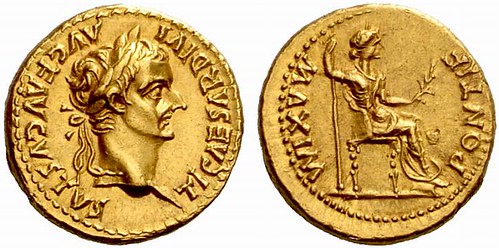
PHOTO OF THE WEEK: A Denarius
This last year, we talked quite a bit about the denarius - a coin worth about a day's wages. Did you ever wonder what one looked like? Very possibly like the photo below.
Labels:
art,
coin,
coinage,
denarius,
photo of the week,
photography
Tuesday, July 9, 2013
Monday, July 8, 2013
DID YOU KNOW: Where did the word "Christian" come from?
"DID YOU KNOW?" will be a summer series where we review issues of the Bible and the Christian faith of special interest. If you have a suggestion/question that you'd like addressed in a "DID YOU KNOW?" segment, please e-mail the coaches.
Where did the word "Christian" come from?
Nowadays, Christ-followers all over the world are called "Christians". It's so common that we don't even question the meaning of the word. Our religion is "Christianity" and so we are called "Christians".
But it is not what early believers called themselves. In Acts, we see the Apostles and earliest followers of Christ referring to their religion as "The Way" and themselves as "Followers of the Way." In fact, the earliest uses of the term "Christian" are not by believers, but their opponents (Acts 11:26 & Acts 26:28). And only in 1 Peter 4:16 - written between 60 and 100 A.D. when he was an old man - does a writer of scripture use the term in a positive light.
"Christian" literally means "little Christ". It was intended as an insult. But early believers, after initially disliking the term, decided to embrace it as their own. After all, in the end, what we all want is to be "little Christs" - people striving to be like Jesus in our world, to show humanity the love of God.
Where did the word "Christian" come from?
Nowadays, Christ-followers all over the world are called "Christians". It's so common that we don't even question the meaning of the word. Our religion is "Christianity" and so we are called "Christians".
But it is not what early believers called themselves. In Acts, we see the Apostles and earliest followers of Christ referring to their religion as "The Way" and themselves as "Followers of the Way." In fact, the earliest uses of the term "Christian" are not by believers, but their opponents (Acts 11:26 & Acts 26:28). And only in 1 Peter 4:16 - written between 60 and 100 A.D. when he was an old man - does a writer of scripture use the term in a positive light.
"Christian" literally means "little Christ". It was intended as an insult. But early believers, after initially disliking the term, decided to embrace it as their own. After all, in the end, what we all want is to be "little Christs" - people striving to be like Jesus in our world, to show humanity the love of God.
Labels:
Christian,
did you know,
DIDYOUKNOW,
etymology,
factoid,
history,
language
Sunday, July 7, 2013
HUMOR: Oopsie!
Not mine. From here.
A story was told of a man who had a debt and for a long time failed to settle it with his debtors. One day seated outside his house, he saw his debtors coming and very quickly he called his young son and told him if anybody asks about his whereabouts, he should answer that he has gone for a journey to see his people in another village. He then quickly decided to hide behind a large cabinet in the living room.
When the debtors arrived, they asked the young boy, “Son! Where is your father?” “He said he was going to another village to see his people.” the boy replied. Then debtors asked the boy “When is he coming back?”.
The young boy confused rushed towards the house and to the cabinet shouting, “Dad! When are you coming back?”
Subscribe to:
Posts (Atom)

WEEKLY COMIC: Fish Oil Diet
MUSICAL INTERLUDE: That's How You Forgive