The official website for the Monroe Bible Quiz Team from Beacon Hill Evangelical Free Church.
Showing posts with label DIDYOUKNOW. Show all posts

Wednesday, August 19, 2015

DID YOU KNOW: Where did all the languages at Pentecost come from?

At the day of Pentecost, there surely were a lot of peoples represented...
And how is it that we hear, each of us in his own native language? Parthians and Medes and Elamites and residents of Mesopotamia, Judea and Cappadocia, Pontus and Asia, Phrygia and Pamphylia, Egypt and the parts of Libya belonging to Cyrene, and visitors from Rome, both Jews and proselytes, Cretans and Arabians—we hear them telling in our own tongues the mighty works of God.” (Acts 2:8-11)
...so where did they all come from, geographically?  This handy-dandy map may help you to place them all.


Monday, August 10, 2015

DID YOU KNOW: Why did we switch to ESV?

"DID YOU KNOW?" will be a summer series where we review issues of the Bible and the Christian faith of special interest. If you have a suggestion/question that you'd like addressed in a "DID YOU KNOW?" segment, please e-mail the coaches.

Why did Bible Quizzing switch from the NIV to the ESV as the translation we study?

Since the 1980's, EFCA Bible Quizzing used the New International Version (NIV) for all of our competitions.  It was chosen because of the quality of its scholarship, its readability, and its accuracy.  A few years back, EFCA Bible Quizzing switched to the English Standard Version (ESV).

In 2011, Biblicia - the organization that owns the rights to the NIV - released a new revision to the translation.  Their intention was to update the translation with the newest scholarship, and to reflect changes in the English language since 1984.  Their revisions were significant (see here for a full listing) and especially focussed on introducing gender-neutral language to many scriptures where the existing gender-interpretation could be seen to change the meaning of the text.  After much debate, many Evangelical churches, leaders, and denominations decided they could not endorse the 2011 version.  Biblicia, at the same time, forbid anyone to continue publishing the previous 1984 version.  So, Bible Quizzing needed to decide whether to move to the (controversial) NIV 2011 or consider moving to another translation.

At the same time, a new version - based on the venerable Revised Standard Version (RSV) was released in 2011, called the English Standard Version.  It was widely praised for the quality of its scholarship, its readability, and its accuracy.  (Sound familiar?)  And it was released with liberal electronic licensing (free versions online, free versions on eBooks, and free apps) that would be valuable for study and quizzing.

So, the leadership of EFCA Bible Quizzing decided it was time for a change and announced that we would be moving to the ESV for the 2013-2014 season.

So which translation is really "better"?

The Bible was originally written in Hebrew and Aramaic (Old Testament) and Greek (New Testament).  Anytime you see it in English, it is a translation and decisions must be made.  The best translations balance precision with readability, so that the meaning of the original language comes through without sounding like a foreign language.

The NIV 2011 takes a number of liberties with the text which are controversial.  But it does address some real problems with the original NIV, and is very natural and readable.

The ESV is much more precise, verging on a literal reading of the text.  But that means the language contains a larger vocabulary, sometimes is a bit wooden, and can be harder to read.

Should I be worried about the change?

No.  The ESV is an excellent translation.  Your first day reading it, things may seem a bit strange.  But you will quickly get used to the language.  And the language is a bit more poetic, so you may even find it easier to memorize the FTVs!

Monday, August 3, 2015

DID YOU KNOW: The Feast of the Transfiguration

"DID YOU KNOW?" will be a summer series where we review issues of the Bible and the Christian faith of special interest. If you have a suggestion/question that you'd like addressed in a "DID YOU KNOW?" segment, please e-mail the coaches.

I heard Thursday is the "Feast of the Transfiguration".  What is that?

More liturgical Christian traditions than ours put events onto the calendar to remember both heroes of the faith and the major events of Jesus's life.  The "Feast of the Transfiguration" on August 6 (for most denominations, not all) is set aside to remember the events of the transfiguration recorded in the synoptic gospels.
Now about eight days after these sayings he took with him Peter and John and James and went up on the mountain to pray. And as he was praying, the appearance of his face was altered, and his clothing became dazzling white. And behold, two men were talking with him, Moses and Elijah, who appeared in glory and spoke of his departure, which he was about to accomplish at Jerusalem. Now Peter and those who were with him were heavy with sleep, but when they became fully awake they saw his glory and the two men who stood with him.  And as the men were parting from him, Peter said to Jesus, “Master, it is good that we are here. Let us make three tents, one for you and one for Moses and one for Elijah”—not knowing what he said.  As he was saying these things, a cloud came and overshadowed them, and they were afraid as they entered the cloud. And a voice came out of the cloud, saying, “This is my Son, my Chosen One; listen to him!” And when the voice had spoken, Jesus was found alone. And they kept silent and told no one in those days anything of what they had seen.Luke 9:28-36 ESV
This feast is unusual in not focussing on a single character (in this case Jesus), but is seen as a time to reflect on the mystery of the Trinity where God is one being in three persons.  God the Father, God the Son, and God the Holy Spirit are all worshipped, celebrated, and remembered in this feast.

Monday, July 27, 2015

DID YOU KNOW: Does the New Testament refer to the Old Testament?

"DID YOU KNOW?" will be a summer series where we review issues of the Bible and the Christian faith of special interest. If you have a suggestion/question that you'd like addressed in a "DID YOU KNOW?" segment, please e-mail the coaches.

Does the New Testament refer to the Old Testament?

Some Christians tend to focus only on the New Testament when studying the Bible, but the whole Bible is the Word of God.  And the New Testament makes references to the Old Testament all the time.  As a matter of fact, Jesus knew the Old Testament by heart, and quoted from it often.

The most commonly quoted books of the Old Testament in the New Testament are:
1. Isaiah: referred to 419 times in twenty-three New Testament books.2. Psalms: referred to 414 times in twenty-three New Testament books.3. Genesis: referred to 260 times in twenty-one New Testament books. 4. Exodus: referred to 250 times in nineteen New Testament books. 5. Deuteronomy: referred to 208 times in twenty-one New Testament books. 6. Ezekiel: referred to 141 times in fifteen New Testament books. 7. Daniel: referred to 133 times in seventeen New Testament books. 8. Jeremiah: referred to 125 times in seventeen New Testament books. 9. Leviticus: referred to 107 times in fifteen New Testament books. 10. Numbers: referred to 73 times in four New Testament books.

Wednesday, July 22, 2015

DID YOU KNOW: The Feast of Mary Magdalene

"DID YOU KNOW?" will be a summer series where we review issues of the Bible and the Christian faith of special interest. If you have a suggestion/question that you'd like addressed in a "DID YOU KNOW?" segment, please e-mail the coaches.

I heard July 22 is the "Feast of Mary Magdalene".  What is that?

Unlike our tradition, Catholic, Eastern Orthodox, and Lutheran churches celebrate feasts for the great heroes of the Faith (whom they call "Saints").  The Feast on July 22 commemorates Mary Magdalene, the sister of Martha and Lazarus.  She is the most commonly mentioned woman in the New Testament, and was at both Christ's crucifixion and resurrection.


Monday, July 20, 2015

DID YOU KNOW: Were there ever any misprints in Bible editions?

"DID YOU KNOW?" will be a summer series where we review issues of the Bible and the Christian faith of special interest. If you have a suggestion/question that you'd like addressed in a "DID YOU KNOW?" segment, please e-mail the coaches.

Skeptics are often looking for errors in the Bible.  Were there ever any documented misprints in Bible editions?

The Holy Bible, as written, is inerrant and inspired by the Holy Spirit.  But various editions printed by humans - copied from the originals or copied from copies - have had errors over the years.  But, as you'd expect, these errors were quickly discovered and resolved.  This article covers some famous misprints.
The "Placemakers" Bible The second edition of the Geneva Bible, published in 1562 has been given the name the "Placemakers" Bible because it printed: "Blessed are the placemakers" instead of "peacemakers" in Matthew 5:9.The "Wicked" Bible In a 1631 edition of the King James Bible, in Exodus 20 verse 14, the word "not" was left out. This changed the 7th commandment to read, "Thou shalt commit adultery." Most of the copies were recalled immediately and destroyed on the orders of Charles I. But there are 11 copies still remaining. They are known as the "Wicked" Bible. The Bible museum in Branson, Missouri, has one copy of the "Wicked Bible". Fortunately for this interesting Bible fact the printer was fined heavily for his mistake.
The "Sin On" Bible In the 1716 King James Version John 8:11 should read: "Go, and sin no more." However, the printer accidentally inverted the "n" and the "o" in the word "on," so it read, "Go and sin on more."
The "Fool" Bible The printer of the 1763 KJV was ordered to pay £3,000 for his inadvertent printer's error which he made in Psalm 14:1. There he printed: "the fool hath said in his heart there is a God," instead of: "the fool hath said in his heart there is no God." As soon as this error was spotted all copies of this Bible were suppressed.

Monday, July 13, 2015

DID YOU KNOW: Where was the Holy Spirit in the Old Testament?

"DID YOU KNOW?" will be a summer series where we review issues of the Bible and the Christian faith of special interest. If you have a suggestion/question that you'd like addressed in a "DID YOU KNOW?" segment, please e-mail the coaches.

Where was the Holy Spirit in the times of the Old Testament?

We previously discussed where Jesus was before the New Testament, but it is even more logical to ask that question about the Holy Spirit.  Jesus and the Apostles are very clear that the Holy Spirit is God and is part of the Trinity (along with the Father and Jesus, the Son).  If that is the case, why did it take until the New Testament to learn about Him?

But it turns out that - like Jesus - the Holy Spirit is all over the Old Testament, once you know what to look for.  The first mention is Genesis 1:2.
The earth was without form and void, and darkness was over the face of the deep. And the Spirit of God was hovering over the face of the waters.  (Genesis 1:2 ESV)
And it pops up again just a few chapters later in Genesis 6:1-3.
When man began to multiply on the face of the land and daughters were born to them, the sons of God saw that the daughters of man were attractive. And they took as their wives any they chose. Then the Lord said, “My Spirit shall not abide in[a] man forever, for he is flesh: his days shall be 120 years.” (Genesis 6:1-3 ESV)
The "Spirit of God" or "God's Spirit" or "My Spirit" appears all over the Old Testament.  The last reference is in Malachi 2:15.

Did he not make them one, with a portion of the Spirit in their union? And what was the one God seeking? Godly offspring. So guard yourselves in your spirit, and let none of you be faithless to the wife of your youth. (Malachi 2:15 ESV)
So, if the Holy Spirit appeared all over the Old Testament, what the special significance of Pentecost?  Before this event, the Holy Spirit would endwell or empower just one person at a time.  For instance, it came upon King Saul when he was anointed king of Israel by Samuel, but then left him and eventually came upon King David when he was anointed king.  After Pentecost, anyone who became a Christian received the Holy Spirit, and could be empowered by Him.

God is the same yesterday, today, and forever.  Anytime you think the Old Testament and the new Testament might be in conflict, check again!

Monday, July 6, 2015

DID YOU KNOW: *More* Biblical Stats

"DID YOU KNOW?" will be a summer series where we review issues of the Bible and the Christian faith of special interest. If you have a suggestion/question that you'd like addressed in a "DID YOU KNOW?" segment, please e-mail the coaches.

What are some MORE interesting statistics about the Bible?

People seemed to enjoy the first list of interesting stats about the Bible, so here's a follow-up with even more statistics for your ledger.
  • Number of books in the Bible: 66 
  • Chapters: 1,189 
  • Verses: 31,101 
  • Words: 783,137 
  • Letters: 3,566,480 
  • Number of promises given in the Bible: 1,260 
  • Commands: 6,468 
  • Predictions: over 8,000 
  • Fulfilled prophecy: 3,268 verses
  • Number of times the word "God" appears: 3,358 
  • Number of times the word "Lord" appears: 7,736 
  • Number of languages the Bible has been translated into: over 1,200

Monday, June 29, 2015

DID YOU KNOW: Where was Jesus before the New Testament?

"DID YOU KNOW?" will be a summer series where we review issues of the Bible and the Christian faith of special interest. If you have a suggestion/question that you'd like addressed in a "DID YOU KNOW?" segment, please e-mail the coaches.

Where was Jesus before he was born in 1 B.C.?

The Bible is very clear about the identity of Jesus Christ:
  1. He is the Son of God
  2. He is God (part of the Trinity)
  3. He was involved in the creation of the world
So, if Jesus is God and God is eternal (always existing), then where was Jesus before the New Testament begins?  This is a question that has sent Christians from the earliest times searching the Old Testament.

First, nowhere in the Old Testament is there a character known as "Jesus" who is obviously the same person.  ("Jesus" is the same name as Joshua, but the Joshua we know from Moses time is NOT the son of God.)  This is one reason why the Jews of his own time were perplexed when he appeared.  Many had come claiming to be the Messiah, so until there was proof he was just one more potential charlatan.

Second, there is evidence that the Trinity has been there from the beginning.  In Genesis, God refers to Himself as "we" and "us" repeatedly during creation.  (Of course, this is not proof, merely evidence.  The story of Creation is poetry, which allows some linguistic freedom, and there are cases of human kings referring to themselves as "we" and "us", as well.)
Then God said, “Let us make man in our image, after our likeness. And let them have dominion over the fish of the sea and over the birds of the heavens and over the livestock and over all the earth and over every creeping thing that creeps on the earth.” - Genesis 1:26
Third, there is a character int he Old Testament who shows up again and again, who is always doing God's work, and who appears to have great power.  He is called "the Angel of the Lord" and is always associated with an appearance of God Himself.
...and there are many more appearances.  Did you notice a common theme in all of these cases?  The Angel of the Lord is a savior.  He speaks for God and he opposes Satan.  This is almost exactly the way Jesus presented himself in the New Testament.  

It is likely that this Angel of the Lord is in fact Jesus before his birth to Mary.

Monday, June 22, 2015

DID YOU KNOW: Some Biblical Stats

"DID YOU KNOW?" will be a summer series where we review issues of the Bible and the Christian faith of special interest. If you have a suggestion/question that you'd like addressed in a "DID YOU KNOW?" segment, please e-mail the coaches.

What are some interesting statistics about the Bible?

The Bible is a long book (or rather collection of books) and has been around for a long time, so scholars have had plenty of time to crunch the numbers.
  • About 50 Bibles are sold every minute.
  • There are 66 books in the Bible, 39 in the Old Testament and 27 in the New Testament.
  • The 66 books of the Bible is divided into 1,189 chapters consisting of 31,173 verses. 
  • The Old Testament has 929 chapters, the New Testament 260.
  • The longest line in the Bible is Esther 8:9 - 89 words, 425 letters. 
  • The longest word in the Bible is Maher-shalal-hash-baz: Isaiah 8:1.
  • The shortest verse in the NIV Bible is John 11:35: "Jesus wept."
  • The longest book chapter in the Bible is Psalm 119, the shortest is Psalm 117.
  • There are 594 chapters before Psalm 118 and 594 chapters after it. 
  • Psalm 118 verse 8 is in the center of the Bible: "It is better to trust in the Lord than put confidence in man."
  • Obadiah, with 21 verses consisting of 602 words, is the shortest book in the Old Testament, and the third shortest in the Bible.
  • II John has the fewest number of verses of any book in the Bible - it is the shortest book in the Bible.
  • III John has the fewest number of words of any book in the Bible.
  • Job is the oldest book written in the Bible - it was written by an unknown Israelite around 1500 BC.

Monday, June 15, 2015

DID YOU KNOW: Where did the word "Christian" come from?

"DID YOU KNOW?" will be a summer series where we review issues of the Bible and the Christian faith of special interest. If you have a suggestion/question that you'd like addressed in a "DID YOU KNOW?" segment, please e-mail the coaches.

Where did the word "Christian" come from?

Nowadays, Christ-followers all over the world are called "Christians".  It's so common that we don't even question the meaning of the word.  Our religion is "Christianity" and so we are called "Christians".

But it is not what early believers called themselves.  In Acts, we see the Apostles and earliest followers of Christ referring to their religion as "The Way" and themselves as "Followers of the Way."  In fact, the earliest uses of the term "Christian" are not by believers, but their opponents (Acts 11:26 & Acts 26:28).  And only in 1 Peter 4:16 - written between 60 and 100 A.D. when he was an old man - does a writer of scripture use the term in a positive light.

"Christian" literally means "little Christ".  It was intended as an insult.  But early believers, after initially disliking the term, decided to embrace it as their own.  After all, in the end, what we all want is to be "little Christs" - people striving to be like Jesus in our world, to show humanity the love of God.

Monday, June 8, 2015

DID YOU KNOW: What are the names of God?

"DID YOU KNOW?" will be a summer series where we review issues of the Bible and the Christian faith of special interest. If you have a suggestion/question that you'd like addressed in a "DID YOU KNOW?" segment, please e-mail the coaches.

What names does God have in the Bible?

Names are very important things in scripture.  God gave new names to many of His chosen people, to signify the change in their status or identity. Abram ("high father") became Abraham ("father of many nations").  Jacob ("deceiver") becomes Israel ("wrestles with God").  A name isn't just an equivalent for "that guy", but rather defines who we are.

So what names does scripture give for God?  You may be surprised just how many names He has!

  • Advocate - 1 John 2:1 
  • Almighty - Revelation 1:8 
  • Alpha - Revelation 1:8 
  • Amen - Revelation 3:14 
  • Angel of the Lord - Genesis 16:7 
  • Anointed One - Psalm 2:2 
  • Author and Perfecter of our Faith - Hebrews 12:2 
  • Beginning - Revelation 21:6 
  • Bishop of Souls - 1 Peter 2:25 
  • Branch - Zechariah 3:8 
  • Bridegroom - Matthew 9:15 
  • Carpenter - Mark 6:3 
  • Chief Shepherd - 1 Peter 5:4 
  • The Christ - Matthew 1:16 
  • Comforter - Jeremiah 8:18 
  • Consolation of Israel - Luke 2:25 
  • Cornerstone - Ephesians 2:20 
  • Dayspring - Luke 1:78 
  • Day Star - 2 Peter 1:19 
  • Deliverer - Romans 11:26 
  • Desire of Nations - Haggai 2:7 
  • End - Revelation 21:6 
  • Everlasting Father - Isaiah 9:6 
  • Faithful and True Witness - Revelation 3:14 
  • First Fruits - 1 Corinthians 15:23 
  • Foundation - Isaiah 28:16 
  • Fountain - Zechariah 13:1 
  • Friend of Sinners - Matthew 11:19 
  • Gate for the Sheep - John 10:7 
  • Gift of God - 2 Corinthians 9:15 
  • God - John 1:1 
  • Glory of God - Isaiah 60:1 
  • Good Shepherd - John 10:11 
  • Governor - Matthew 2:6 
  • Great Shepherd - Hebrews 13:20 
  • Guide - Psalm 48:14
And many more.  Click thru the link for the full list!

Monday, May 25, 2015

DID YOU KNOW: What is Memorial Day all about?

"DID YOU KNOW?" will be a summer series where we review issues of the Bible and the Christian faith of special interest. If you have a suggestion/question that you'd like addressed in a "DID YOU KNOW?" segment, please e-mail the coaches.

What is Memorial Day all about?

These days, most people think of Memorial Day are one of three things:  (1) the first Summer day off of work, (2) the beginning of "Beach Season", or (3) a day to shop the really good sales.  But Memorial Day was set up for something much more serious and somber.

Memorial Day was first declared by General John Logan, national commander of the Grand Army of the Republic of the United States of America in 1868.  The Civil War had ended 3 years before, and he wanted to set aside time to lay flowers on the graves of Union and Confederate soldiers at Arlington National Cemetery.  The war had cost over 620,000 soldier lives (and a total of over 1,030,000 lives - about 3% of the population).  It was important to take a moment to remember those who had laid down their lives for their country (on both sides).  New York was the first state to formally recognize Memorial Day in 1873, and all northern states had recognized it by 1890.  It wasn't until after World War 1 that the practice was picked up by all of the southern states.

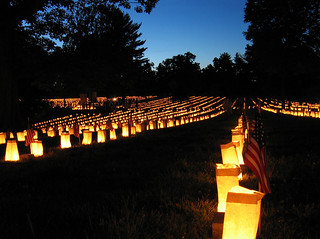
In 1915, the poet Moina Michael came up with the idea of observing Memorial Day with a red poppy, symbolizing the blood shed by heroes, who were only remembered now by the flowers on their graves.Since the late 50's on the Thursday before Memorial Day, the 1,200 soldiers of the 3d U.S. Infantry place small American flags at each of the more than 260,000 gravestones at Arlington National Cemetery. They then patrol 24 hours a day during the weekend to ensure that each flag remains standing. In 1951, the Boy Scouts and Cub Scouts of St. Louis began placing flags on the 150,000 graves at Jefferson Barracks National Cemetery as an annual Good Turn, a practice that continues to this day. In 1998, on the Saturday before the observed day for Memorial Day, the Boys Scouts and Girl Scouts began placing a candle at each of approximately 15,300 grave sites of soldiers buried at Fredericksburg and Spotsylvania National Military Park on Marye's Heights.  In 2000, Congress passed the "Moment of Remembrance" calling on all Americans to observe a moment of silence (and prayer) at 3:00 PM on Memorial Day to remember Americans who died fighting in our wars.

Take a moment today and pray about this.  Thank God for living in a land of religious freedom, and thank Him for those men and women who have died to protect that freedom.

Memorial Day
Source:  http://www.usmemorialday.org/backgrnd.html

Monday, May 18, 2015

DID YOU KNOW: Who were the human authors of the Bible?

"DID YOU KNOW?" will be a summer series where we review issues of the Bible and the Christian faith of special interest. If you have a suggestion/question that you'd like addressed in a "DID YOU KNOW?" segment, please e-mail the coaches.

Who wrote the Bible, in a human sense?

The Bible is not one book, but a collection of books written by a number of men (as inspired by the Holy Spirit) across the centuries. Did you know just how many people were involved with producing the scriptures you hold today?
Genesis, Exodus, Leviticus, Numbers, Deuteronomy = Moses - 1400 B.C.
Joshua = Joshua - 1350 B.C.
Judges, Ruth, 1 Samuel, 2 Samuel = Samuel/Nathan/Gad - 1000 - 900 B.C.
1 Kings, 2 Kings = Jeremiah - 600 B.C.
1 Chronicles, 2 Chronicles, Ezra, Nehemiah = Ezra - 450 B.C.
Esther = Mordecai - 400 B.C.
Job = Moses - 1400 B.C.
Psalms = several different authors, mostly David - 1000 - 400 B.C.
Proverbs, Ecclesiastes, Song of Solomon = Solomon - 900 B.C.
Isaiah = Isaiah - 700 B.C.
Jeremiah, Lamentations = Jeremiah - 600 B.C.
Ezekiel = Ezekiel - 550 B.C.
Daniel = Daniel - 550 B.C.
Hosea = Hosea - 750 B.C.
Joel = Joel - 850 B.C.
Amos = Amos - 750 B.C.
Obadiah = Obadiah - 600 B.C.
Jonah = Jonah - 700 B.C.
Micah = Micah - 700 B.C.
Nahum = Nahum - 650 B.C.
Habakkuk = Habakkuk - 600 B.C.
Zephaniah = Zephaniah - 650 B.C.
Haggai = Haggai - 520 B.C.
Zechariah = Zechariah - 500 B.C.
Malachi = Malachi - 430 B.C.
Matthew = Matthew - A.D. 55
Mark = John Mark - A.D. 50
Luke = Luke - A.D. 60
John = John - A.D. 90
Acts = Luke - A.D. 65
Romans, 1 Corinthians, 2 Corinthians, Galatians, Ephesians, Philippians, Colossians, 1 Thessalonians, 2 Thessalonians, 1 Timothy, 2 Timothy, Titus, Philemon = Paul - A.D. 50-70
Hebrews = unknown, mostly likely Paul, Luke, Barnabas, or Apollos - A.D. 65
James = James - A.D. 45
1 Peter, 2 Peter = Peter - A.D. 60
1 John, 2 John, 3 John = John - A.D. 90
Jude = Jude - A.D. 60
Revelation = John - A.D. 90
From GotQuestions.Org.

Monday, May 11, 2015

DID YOU KNOW: How long did it take to write the Bible?

"DID YOU KNOW?" will be a summer series where we review issues of the Bible and the Christian faith of special interest. If you have a suggestion/question that you'd like addressed in a "DID YOU KNOW?" segment, please e-mail the coaches.

How long did it take to write the whole Bible?

It was written over a period of some 1,500 years, from around 1450 B.C. (the time of Moses) to about 100 A.D. (following the death and resurrection of Jesus Christ)

Monday, May 4, 2015

DID YOU KNOW: How was the Bible put together?

"DID YOU KNOW?" will be a summer series where we review issues of the Bible and the Christian faith of special interest. If you have a suggestion/question that you'd like addressed in a "DID YOU KNOW?" segment, please e-mail the coaches.

How was the Bible put together? How did history decide which books were in and which ones were out?

The current list of books in the Bible - known as the "canon" - was put together in different ways for the Old Testament and New Testament. But despite what some fiction authors might like to claim, the process was not secretive or mysterious.
...there was very little controversy over the canon of the Old Testament. Hebrew believers recognized God’s messengers and accepted their writings as inspired of God. While there was undeniably some debate in regards to the Old Testament canon, by A.D. 250 there was nearly universal agreement on the canon of Hebrew Scripture...

For the New Testament, the process of the recognition and collection began in the first centuries of the Christian church. Very early on, some of the New Testament books were being recognized. Paul considered Luke’s writings to be as authoritative as the Old Testament (1 Timothy 5:18; see also Deuteronomy 25:4 and Luke 10:7). Peter recognized Paul’s writings as Scripture (2 Peter 3:15-16). Some of the books of the New Testament were being circulated among the churches (Colossians 4:16; 1 Thessalonians 5:27). Clement of Rome mentioned at least eight New Testament books (A.D. 95). Ignatius of Antioch acknowledged about seven books (A.D. 115). Polycarp, a disciple of John the apostle, acknowledged 15 books (A.D. 108). Later, Irenaeus mentioned 21 books (A.D. 185). Hippolytus recognized 22 books (A.D. 170-235). The New Testament books receiving the most controversy were Hebrews, James, 2 Peter, 2 John, and 3 John...

The councils followed something similar to the following principles to determine whether a New Testament book was truly inspired by the Holy Spirit: 1) Was the author an apostle or have a close connection with an apostle? 2) Is the book being accepted by the body of Christ at large? 3) Did the book contain consistency of doctrine and orthodox teaching? 4) Did the book bear evidence of high moral and spiritual values that would reflect a work of the Holy Spirit?

Sunday, April 12, 2015

HOLY WEEK LEFTOVERS: Where do the symbols of Easter come from?

Holy Week raises lots of questions worth answering, which we don't always get around to discussing during Holy Week.  We'll take a few days this week to look at those questions.

QUESTION 4:  Easter has a lot of traditions/symbols.  From where do we get the egg, bunny, etc.?

Tradition is always a tricky thing to talk about, because each culture and even sub-culture can have their own traditions.  But traditions almost always go back to a real core of truth, somewhere in their past. Let's go over a few of the most common Easter traditions:

  • Rabbits (The Easter Bunny):  Easter is all about life, and rabbits have long been symbols of life due to their large families.  But there is more to it when it comes to the celebration of the resurrection of Jesus Christ.  The rabbit coming out of her hole is a symbol reminding us of Jesus emerging from his tomb.
  • Eggs (Easter Egg Hunts/Rolls):  Eggs are also symbols of life. And a chick emerging from what previously looked like a lifeless stone is a symbol reminding us (again) of Jesus emerging from the tomb.  The coloring of eggs comes from old traditions which forbade the eating of eggs during Lent (as a symbol of denying oneself) but encouraged their eating at Easter as a celebration.  The rolling of Easter Eggs is symbolic of the stone being rolled away from the opening of the tomb.
  • Candy:  There is nothing subtle about this.  Candy is a sign of celebration and a symbol of the sweetness of life.  Candy makers have, of course, embraced this as a chance to sell every kind of sugary snack imaginable which cover the other symbols of Easter.
  • Parades:  While modern Easter parades don't look much different from Christmas or New Years (or NCAA champion) parades, ancient Easter parades were quite different.  They were made up of new converts to Christianity and people who were newly baptized, wearing white to proclaim to the world that they had been forgiven of their sins.
  • Lilies:  Easter lilies are always purest white, reminding us of the purity of our new life as forgiven people, saved by the blood of Jesus Christ.
  • Sunrise Services:  Well, this one is no mystery.  The women went to the tomb in the early morning, and that is when they discovered - to their great confusion and soon to their great joy - that his corpse was not there.  Jesus was alive!
  • New Clothes for Easter:  The buying and wearing of new clothes at Easter is not just about "looking your best for God".  It is also a symbol of the new life Christ brought us with his death and resurrection, clothing us in his own righteousness.

Saturday, April 11, 2015

HOLY WEEK LEFTOVERS: Why do we call Resurrection Sunday by the name "Easter"?

Holy Week raises lots of questions worth answering, which we don't always get around to discussing during Holy Week.  We'll take a few days this week to look at those questions.

QUESTION 3:  Where does the name "Easter" come from?

This is a big question and hard to answer, because language changes so much over time.  There are two primary theories for the origin of the word "Easter".

Pagan Origins:  Eastre (or Eostre) was a goddess of the Saxon peoples of Northern Europe, associated with Springtime and especially rabbits.  (It is believed this is where the idea of the Easter Bunny may have come from, although the fact that rabbits emerge from a hole in the ground also makes them a natural symbol for Jesus emerging from the tomb.)  This theory is that a feast to Eastre was held in the Springtime. Christian missionaries did not want to deny their converts a chance to celebrate, so instead of banning the old celebration they replaced the former significance with a celebration of the resurrection of Jesus Christ.  The practice of "redeeming" pagan holidays with new Christian significance was quite common in the old Roman Empire.

German Origins:  The german word for "resurrection" is "auferstehung"(say it fast, you can get a sense of how it could have morphed into "easter" over centuries of time).  Under this theory, the word was first used by early German Christians to refer to the time of Passover, reflecting the fact that Resurrection Sunday would historically be the Sunday after Passover.  Over time, the word's use was expanded and expanded as people began to not only note the day on their calendars, but make a celebration out of it.  Finally, the word "Easter" eclipsed Passover in the mind of Christian Europe (much of which had never known a Jewish person or read a Bible, so the significance of the old Hebrew holiday was lost).  This theory is supported by the fact that Easter first appears as a word in German writings, rather than Saxon ones.

Thursday, April 9, 2015

HOLY WEEK LEFTOVERS: Was Jesus really in the tomb for 3 days?

Holy Week raises lots of questions worth answering, which we don't always get around to discussing during Holy Week.  We'll take a few days to look at those questions.

QUESTION 2:  Was Jesus really in the tomb for 3 days?

There are big questions and there are little questions, and this is one that people argue over the size of. Many ask, "If Jesus died Friday night and rose Sunday morning, how does that work out to three days?"  After all, he was only in the tomb for a full day on Sunday, right?

Nope.  First century Jews thought about the calendar differently than moderns do:

  1. Days start at sundown on the Jewish calendar.
  2. People of the time didn't think in 24 hours days, where 3 days meant "exactly 72 hours".  Rather, they thought in terms of day periods.  For something to happen "on the third day" was always considered to mean "sometime during the third day".  (72 hours later would be "on the fourth day".)
  3. When Jews of the time spoke about "three days and three nights", partial days were considered sufficient.  In Esther 4 and 5, she fasts "for 3 days and 3 nights" but goes to the king "on the third day". 
Thus, Jesus being in the tomb for three days was fulfilled by:  


  1. Some time on Friday (Jesus died in the afternoon, before sunset)
  2. All day on Saturday
  3. Some time on Sunday (Jesus was seen by the women in the morning)
3 days, even though it was not 72 hours later.

Wednesday, April 8, 2015

HOLY WEEK LEFTOVERS: How do we know Jesus actually rose?

Holy Week raises lots of questions worth answering, which we don't always get around to discussing during Holy Week.  We'll take a few days this week to look at those questions.

QUESTION 1:  HOW DO WE KNOW JESUS ACTUALLY ROSE FROM THE DEAD?

Since the very day Jesus rose from the dead, people have been trying to argue it didn't happen.  (The gospels actually record an attempted payoff from the Sanhedrin to the tomb guards to claim the disciples had stolen the body.)  But there is plentiful evidence that Jesus died and that he rose again!

  1. Jesus Died:  The Romans were experts at killing and crucifixion was one of their go-to methods for killing.  The gospels even record that the guards at the cross were ready with a backup plan for anyone who hadn't died.  They would break their legs, so they couldn't push themselves up to catch a breath.  Instead, when they came to Jesus, they saw he was dead.  But just to make sure, they thrust a spear into his side.  The gospels report "blood and water" flowed, which either indicates that the blood had begun to coagulate inside the body, or that the cardiac sack around the heart had been punctured.  Either way, there is now way to survive that.
  2. Jesus Rose:  First century Jews were no fools and were used to Messiahs who didn't deliver what they promised, so it makes little sense to chalk up Jesus's appearances to superstition.  Instead, the gospels report repeatedly that there were eyewitnesses to the resurrected Christ.  First, he appeared to the women who came to the tomb to care for his body.  Second, he appeared to Peter (and John saw the empty tomb).  Third, he appeared to two unnamed disciples on the way to Emmaus.  Fourth, he appeared to all of the disciples in the upper room, except Thomas.  Finally, he appeared to Thomas, as well, and even showed him the scars in his hands, his feet, and his sides.  And it was not just the apostles who saw him, but Paul reports in 1 Corinthians 15:6 that over 500 people saw Jesus alive (most of whom were still alive when he wrote for readers to check back with).
  3. Jesus Changed Lives:  Finally, it is worth noting the transformation seen in the disciples after Jesus's resurrection.  After the crucifixion, all accounts report they were terrified and hidden away, fearing the Romans or Sanhedrin would come for them next.  They feared for their lives, and were ready to run away.  But after the resurrection, suddenly they are bold and brash men with no fear for their lives.  They preach, they teach, they do miracles, and they eagerly march toward martyrdom.

While we do not have a photograph of the risen Jesus to examine, all of this adds up to a lot of strong evidence that Jesus of Nazareth did indeed rise from the dead.