“Part of this project involved combing through hundreds of sources throughout the American Revolutionary War era and before to determine exactly what the most popular biblical texts were,” Byrd said. “For example, the story of the Israelites’ exodus from Egypt was huge for the American colonists. Many viewed King George as the ‘British pharaoh.’ In addition, some of the early patriots compared themselves to David in the first book of Samuel, where David successfully battled the Philistine giant named Goliath.”Also, Thomas Paine’s Common Sense was one of the most important books written during that period. “Common Sense convinced so many people that they needed to cast off this king and declare their independence,” Byrd said. “It’s full of biblical references, yet Paine was neither a Christian nor a biblical scholar. Yet he knew that in order to convince the largest population possible, he must be knowledgeable about scripture.”
Saturday, July 20, 2013
BIBLE NEWS: Book Examines the Bible's Influence on American Revolution
Our nation's history is deeply steeped in Biblical principles, but it still comes as a surprise to many modern scholars just how Biblically-literate the founders were. In a new book, one author examines how the Founding Fathers - many of whom were not weekly churchgoers - studied the Bible and used it's principles in waging war during the Revolution.
Labels:
America,
bible,
bible news,
book,
history,
news,
revolution,
study
Friday, July 19, 2013
Thursday, July 18, 2013
GETTING READY: To whom was Romans written?
The first book we'll be studying for the 2013-2014 season will be the epistle to the Romans. The next few weeks of the "Getting Ready" series, we will be considering the high-level questions about this book. If you have additional questions, don't be shy about e-mailing the coaches!
To whom was the epistle to the Romans written?
This again may seem like an obvious answer, given the title of the book, and the introduction from Paul in Romans 1:7:
First, we know that Rome was a church that had started and thrived without having been planted by an apostle. Paul, after his arrest in Acts 21, will eventually be sent to Rome as a prisoner and will bring the gospel to many people in the capital city. But up until this time, they have had to make due with second-level teachers and leaders. This explains why Romans sometimes reads like "Intro to Christianity", laying out the basics of the faith. The Romans had never heard real doctrine before!
Second, we know that the Roman church contained both Jews and Gentiles (Gentiles - for those who may have forgotten - means "any non-Jew"). This created a good deal of tension in the church, because Jews observed the whole Mosaic law in addition to Christianity while Gentiles just wanted to follow the teachings of Jesus. This pattern will be played out again and again in the early church, as Jewish Christians want to make Gentiles more Jewish, while Gentile Christians want to make Jews act more like Gentiles. But this explains why Paul will spend a good deal of this book laying out the differences and similarities between Jew and Gentile.
Third, we know that Paul had high hopes for Rome. If the capital of the Roman Empire were to become Christian, it greatly increased the possibility the gospel would eventually reach the whole Roman world. At this time in history, the Empire reached from Spain in the East to India in the West, from Britain in the North to Africa in the South. It was the greatest empire that had ever existed, and offered a chance to communicate the gospel in a common language to the whole known world.
To whom was the epistle to the Romans written?
This again may seem like an obvious answer, given the title of the book, and the introduction from Paul in Romans 1:7:
To all those in Rome who are loved by God and called to be saints:But what do we really know about the Roman church? The book's content tells us a lot about them.
Grace to you and peace from God our Father and the Lord Jesus Christ.
Romans 1:7
First, we know that Rome was a church that had started and thrived without having been planted by an apostle. Paul, after his arrest in Acts 21, will eventually be sent to Rome as a prisoner and will bring the gospel to many people in the capital city. But up until this time, they have had to make due with second-level teachers and leaders. This explains why Romans sometimes reads like "Intro to Christianity", laying out the basics of the faith. The Romans had never heard real doctrine before!
Second, we know that the Roman church contained both Jews and Gentiles (Gentiles - for those who may have forgotten - means "any non-Jew"). This created a good deal of tension in the church, because Jews observed the whole Mosaic law in addition to Christianity while Gentiles just wanted to follow the teachings of Jesus. This pattern will be played out again and again in the early church, as Jewish Christians want to make Gentiles more Jewish, while Gentile Christians want to make Jews act more like Gentiles. But this explains why Paul will spend a good deal of this book laying out the differences and similarities between Jew and Gentile.
Third, we know that Paul had high hopes for Rome. If the capital of the Roman Empire were to become Christian, it greatly increased the possibility the gospel would eventually reach the whole Roman world. At this time in history, the Empire reached from Spain in the East to India in the West, from Britain in the North to Africa in the South. It was the greatest empire that had ever existed, and offered a chance to communicate the gospel in a common language to the whole known world.
Labels:
epistles,
getting ready,
getting started,
introduction,
letter,
recipients,
romans,
rome,
to who,
to whom
Wednesday, July 17, 2013
PHOTO OF THE WEEK: A Tomb like Jesus Was Laid In
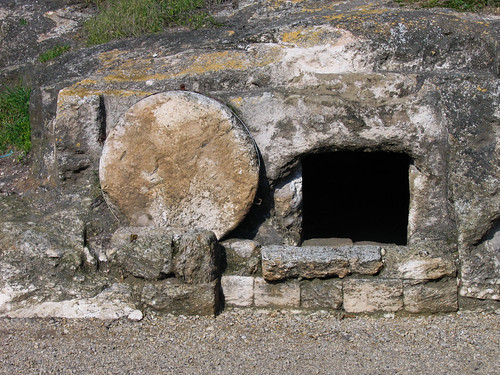
Have you ever wondered what the tomb that Jesus was laid in on Good Friday looked like? This isn't the same one, but gives you a good idea of how it may have looked.
Labels:
archeology,
easter,
jesus,
photo of the week,
photography,
tomb
Tuesday, July 16, 2013
Monday, July 15, 2013
DID YOU KNOW: Some Biblical Stats
"DID YOU KNOW?" will be a summer series where we review issues of the Bible and the Christian faith of special interest. If you have a suggestion/question that you'd like addressed in a "DID YOU KNOW?" segment, please e-mail the coaches.
What are some interesting statistics about the Bible?
The Bible is a long book (or rather collection of books) and has been around for a long time, so scholars have had plenty of time to crunch the numbers.
What are some interesting statistics about the Bible?
The Bible is a long book (or rather collection of books) and has been around for a long time, so scholars have had plenty of time to crunch the numbers.
- About 50 Bibles are sold every minute.
- There are 66 books in the Bible, 39 in the Old Testament and 27 in the New Testament.
- The 66 books of the Bible is divided into 1,189 chapters consisting of 31,173 verses.
- The Old Testament has 929 chapters, the New Testament 260.
- The longest line in the Bible is Esther 8:9 - 89 words, 425 letters.
- The longest word in the Bible is Maher-shalal-hash-baz: Isaiah 8:1.
- The shortest verse in the NIV Bible is John 11:35: "Jesus wept."
- The longest book chapter in the Bible is Psalm 119, the shortest is Psalm 117.
- There are 594 chapters before Psalm 118 and 594 chapters after it.
- Psalm 118 verse 8 is in the center of the Bible: "It is better to trust in the Lord than put confidence in man."
- Obadiah, with 21 verses consisting of 602 words, is the shortest book in the Old Testament, and the third shortest in the Bible.
- II John has the fewest number of verses of any book in the Bible - it is the shortest book in the Bible.
- III John has the fewest number of words of any book in the Bible.
- Job is the oldest book written in the Bible - it was written by an unknown Israelite around 1500 BC.
Labels:
did you know,
DIDYOUKNOW,
factoid,
facts,
numbers,
statistics,
stats,
trivia
Sunday, July 14, 2013
HUMOR: Honoring the Departed
Not mine. From here.
A pastor was walking through the church and spotted young Billy fixated on the back wall.
Pastor: “What are you looking at, Billy?”
Billy: “Pastor, why are there names on all these bricks?”
Pastor (solemnly): “Those are the names of people who have died in the service”
Billy: “Oh... Was that the 8:30 Service, or the 11:00 Service?
Subscribe to:
Posts (Atom)

WEEKLY COMIC: The Value of Opinions
MUSICAL INTERLUDE: God of Brilliant Lights