The official website for the Monroe Bible Quiz Team from Beacon Hill Evangelical Free Church.
Showing posts with label holy week. Show all posts

Sunday, April 12, 2015

HOLY WEEK LEFTOVERS: Where do the symbols of Easter come from?

Holy Week raises lots of questions worth answering, which we don't always get around to discussing during Holy Week.  We'll take a few days this week to look at those questions.

QUESTION 4:  Easter has a lot of traditions/symbols.  From where do we get the egg, bunny, etc.?

Tradition is always a tricky thing to talk about, because each culture and even sub-culture can have their own traditions.  But traditions almost always go back to a real core of truth, somewhere in their past. Let's go over a few of the most common Easter traditions:

  • Rabbits (The Easter Bunny):  Easter is all about life, and rabbits have long been symbols of life due to their large families.  But there is more to it when it comes to the celebration of the resurrection of Jesus Christ.  The rabbit coming out of her hole is a symbol reminding us of Jesus emerging from his tomb.
  • Eggs (Easter Egg Hunts/Rolls):  Eggs are also symbols of life. And a chick emerging from what previously looked like a lifeless stone is a symbol reminding us (again) of Jesus emerging from the tomb.  The coloring of eggs comes from old traditions which forbade the eating of eggs during Lent (as a symbol of denying oneself) but encouraged their eating at Easter as a celebration.  The rolling of Easter Eggs is symbolic of the stone being rolled away from the opening of the tomb.
  • Candy:  There is nothing subtle about this.  Candy is a sign of celebration and a symbol of the sweetness of life.  Candy makers have, of course, embraced this as a chance to sell every kind of sugary snack imaginable which cover the other symbols of Easter.
  • Parades:  While modern Easter parades don't look much different from Christmas or New Years (or NCAA champion) parades, ancient Easter parades were quite different.  They were made up of new converts to Christianity and people who were newly baptized, wearing white to proclaim to the world that they had been forgiven of their sins.
  • Lilies:  Easter lilies are always purest white, reminding us of the purity of our new life as forgiven people, saved by the blood of Jesus Christ.
  • Sunrise Services:  Well, this one is no mystery.  The women went to the tomb in the early morning, and that is when they discovered - to their great confusion and soon to their great joy - that his corpse was not there.  Jesus was alive!
  • New Clothes for Easter:  The buying and wearing of new clothes at Easter is not just about "looking your best for God".  It is also a symbol of the new life Christ brought us with his death and resurrection, clothing us in his own righteousness.

Saturday, April 11, 2015

HOLY WEEK LEFTOVERS: Why do we call Resurrection Sunday by the name "Easter"?

Holy Week raises lots of questions worth answering, which we don't always get around to discussing during Holy Week.  We'll take a few days this week to look at those questions.

QUESTION 3:  Where does the name "Easter" come from?

This is a big question and hard to answer, because language changes so much over time.  There are two primary theories for the origin of the word "Easter".

Pagan Origins:  Eastre (or Eostre) was a goddess of the Saxon peoples of Northern Europe, associated with Springtime and especially rabbits.  (It is believed this is where the idea of the Easter Bunny may have come from, although the fact that rabbits emerge from a hole in the ground also makes them a natural symbol for Jesus emerging from the tomb.)  This theory is that a feast to Eastre was held in the Springtime. Christian missionaries did not want to deny their converts a chance to celebrate, so instead of banning the old celebration they replaced the former significance with a celebration of the resurrection of Jesus Christ.  The practice of "redeeming" pagan holidays with new Christian significance was quite common in the old Roman Empire.

German Origins:  The german word for "resurrection" is "auferstehung"(say it fast, you can get a sense of how it could have morphed into "easter" over centuries of time).  Under this theory, the word was first used by early German Christians to refer to the time of Passover, reflecting the fact that Resurrection Sunday would historically be the Sunday after Passover.  Over time, the word's use was expanded and expanded as people began to not only note the day on their calendars, but make a celebration out of it.  Finally, the word "Easter" eclipsed Passover in the mind of Christian Europe (much of which had never known a Jewish person or read a Bible, so the significance of the old Hebrew holiday was lost).  This theory is supported by the fact that Easter first appears as a word in German writings, rather than Saxon ones.

Thursday, April 9, 2015

HOLY WEEK LEFTOVERS: Was Jesus really in the tomb for 3 days?

Holy Week raises lots of questions worth answering, which we don't always get around to discussing during Holy Week.  We'll take a few days to look at those questions.

QUESTION 2:  Was Jesus really in the tomb for 3 days?

There are big questions and there are little questions, and this is one that people argue over the size of. Many ask, "If Jesus died Friday night and rose Sunday morning, how does that work out to three days?"  After all, he was only in the tomb for a full day on Sunday, right?

Nope.  First century Jews thought about the calendar differently than moderns do:

  1. Days start at sundown on the Jewish calendar.
  2. People of the time didn't think in 24 hours days, where 3 days meant "exactly 72 hours".  Rather, they thought in terms of day periods.  For something to happen "on the third day" was always considered to mean "sometime during the third day".  (72 hours later would be "on the fourth day".)
  3. When Jews of the time spoke about "three days and three nights", partial days were considered sufficient.  In Esther 4 and 5, she fasts "for 3 days and 3 nights" but goes to the king "on the third day". 
Thus, Jesus being in the tomb for three days was fulfilled by:  


  1. Some time on Friday (Jesus died in the afternoon, before sunset)
  2. All day on Saturday
  3. Some time on Sunday (Jesus was seen by the women in the morning)
3 days, even though it was not 72 hours later.

Wednesday, April 8, 2015

HOLY WEEK LEFTOVERS: How do we know Jesus actually rose?

Holy Week raises lots of questions worth answering, which we don't always get around to discussing during Holy Week.  We'll take a few days this week to look at those questions.

QUESTION 1:  HOW DO WE KNOW JESUS ACTUALLY ROSE FROM THE DEAD?

Since the very day Jesus rose from the dead, people have been trying to argue it didn't happen.  (The gospels actually record an attempted payoff from the Sanhedrin to the tomb guards to claim the disciples had stolen the body.)  But there is plentiful evidence that Jesus died and that he rose again!

  1. Jesus Died:  The Romans were experts at killing and crucifixion was one of their go-to methods for killing.  The gospels even record that the guards at the cross were ready with a backup plan for anyone who hadn't died.  They would break their legs, so they couldn't push themselves up to catch a breath.  Instead, when they came to Jesus, they saw he was dead.  But just to make sure, they thrust a spear into his side.  The gospels report "blood and water" flowed, which either indicates that the blood had begun to coagulate inside the body, or that the cardiac sack around the heart had been punctured.  Either way, there is now way to survive that.
  2. Jesus Rose:  First century Jews were no fools and were used to Messiahs who didn't deliver what they promised, so it makes little sense to chalk up Jesus's appearances to superstition.  Instead, the gospels report repeatedly that there were eyewitnesses to the resurrected Christ.  First, he appeared to the women who came to the tomb to care for his body.  Second, he appeared to Peter (and John saw the empty tomb).  Third, he appeared to two unnamed disciples on the way to Emmaus.  Fourth, he appeared to all of the disciples in the upper room, except Thomas.  Finally, he appeared to Thomas, as well, and even showed him the scars in his hands, his feet, and his sides.  And it was not just the apostles who saw him, but Paul reports in 1 Corinthians 15:6 that over 500 people saw Jesus alive (most of whom were still alive when he wrote for readers to check back with).
  3. Jesus Changed Lives:  Finally, it is worth noting the transformation seen in the disciples after Jesus's resurrection.  After the crucifixion, all accounts report they were terrified and hidden away, fearing the Romans or Sanhedrin would come for them next.  They feared for their lives, and were ready to run away.  But after the resurrection, suddenly they are bold and brash men with no fear for their lives.  They preach, they teach, they do miracles, and they eagerly march toward martyrdom.

While we do not have a photograph of the risen Jesus to examine, all of this adds up to a lot of strong evidence that Jesus of Nazareth did indeed rise from the dead.

Sunday, April 5, 2015

HOLY WEEK: Resurrection Sunday!

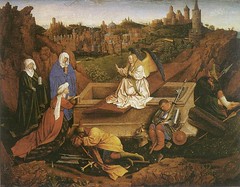
The Three Marys at the Tomb by Hubert van Eyck
After the Sabbath, at dawn on the first day of the week, Mary Magdalene and the other Mary went to look at the tomb.
There was a violent earthquake, for an angel of the Lord came down from heaven and, going to the tomb, rolled back the stone and sat on it. His appearance was like lightning, and his clothes were white as snow. The guards were so afraid of him that they shook and became like dead men.
The angel said to the women, “Do not be afraid, for I know that you are looking for Jesus, who was crucified. He is not here; he has risen, just as he said. Come and see the place where he lay. Then go quickly and tell his disciples: ‘He has risen from the dead and is going ahead of you into Galilee. There you will see him.’ Now I have told you.”
So the women hurried away from the tomb, afraid yet filled with joy, and ran to tell his disciples. Suddenly Jesus met them. “Greetings,” he said. They came to him, clasped his feet and worshiped him. 10 Then Jesus said to them, “Do not be afraid. Go and tell my brothers to go to Galilee; there they will see me.”

Saturday, April 4, 2015

HOLY WEEK: Holy Saturday

It is typical to think of Saturday as an "off day" for Holy Week, but actually quite a lot was happening.  Jesus was taken down from the cross and his body was wrapped in fine cloths and spices.   Then Nicodemus and Joseph of Arimathea - both prominent men who had much to lose by declaring they were followers of Jesus - came forward to claim the body and place it into a rich tomb.  Finally, the Sanhedrin - aware of Jesus's prophesies about resurrection - convinced Pilate to seal the tomb and guard it to protect against tampering.


Thursday, April 2, 2015

HOLY WEEK: Maundy Thursday

Maundy Thursday is the most solemn and somber of days in the Christian calendar.  It marks the day that Jesus gave the Last Supper, prayed in the Garden of Gethsemane, and was betrayed by Judas.

The term "Maundy" is a reference back to the Latin "mandatum" - i.e. "command" - which comes from John 13:34-35:  "A new commandment I give to you, that you love one another: just as I have loved you, you also are to love one another. By this all people will know that you are my disciples, if you have love for one another.”"

Why is this day more somber than "Good Friday" on which Jesus actually died?  Because that day is made "good" by the redemption accomplished by his death on the cross.  Thursday, on the other hand, is just one difficult moment for Jesus after another with no relief in sight.  In light of this, it is traditional for Maundy Thursday services to end in silence, with people leaving the church without talking.


Wednesday, April 1, 2015

HOLY WEEK: Silent Wednesday

Nothing is recorded in the gospels about Wednesday of Holy Week.  This certainly doesn't say "nothing" happened, but scholars speculate Jesus and his disciples may have spent the day resting up for the Passover celebration in Bethany with Mary, Martha, and Lazarus.


Tuesday, March 31, 2015

HOLY WEEK: The Olivet Discourse & Judas In Negotiations

Tuesday of Holy Week was the day Jesus went up on the Mount of Olives to give the "Olivet Discourse" - a long sermon focussed around prophesies of the coming destruction of Jerusalem and ultimately the End Times.  It is also the day that Judas negotiated the price to betray Jesus (Matthew 24:14-16)

Monday, March 30, 2015

HOLY WEEK: Clearing of the Temple

On Monday of Holy Week, the major event was Jesus's cleansing of the Temple, recorded in all four gospels.
And they came to Jerusalem. And he entered the temple and began to drive out those who sold and those who bought in the temple, and he overturned the tables of the money-changers and the seats of those who sold pigeons. And he would not allow anyone to carry anything through the temple. And he was teaching them and saying to them, “Is it not written, ‘My house shall be called a house of prayer for all the nations’? But you have made it a den of robbers.” And the chief priests and the scribes heard it and were seeking a way to destroy him, for they feared him, because all the crowd was astonished at his teaching. And when evening came they went out of the city.  (Mark 11:15-19)

Saturday, April 26, 2014

HOLY WEEK LEFTOVERS: Where do the symbols of Easter come from?

Holy Week raises lots of questions worth answering, which we don't always get around to discussing during Holy Week.  We'll take a few days this week to look at those questions.

QUESTION 4:  Easter has a lot of traditions/symbols.  From where do we get the egg, bunny, etc.?

Tradition is always a tricky thing to talk about, because each culture and even sub-culture can have their own traditions.  But traditions almost always go back to a real core of truth, somewhere in their past. Let's go over a few of the most common Easter traditions:

  • Rabbits (The Easter Bunny):  Easter is all about life, and rabbits have long been symbols of life due to their large families.  But there is more to it when it comes to the celebration of the resurrection of Jesus Christ.  The rabbit coming out of her hole is a symbol reminding us of Jesus emerging from his tomb.
  • Eggs (Easter Egg Hunts/Rolls):  Eggs are also symbols of life. And a chick emerging from what previously looked like a lifeless stone is a symbol reminding us (again) of Jesus emerging from the tomb.  The coloring of eggs comes from old traditions which forbade the eating of eggs during Lent (as a symbol of denying oneself) but encouraged their eating at Easter as a celebration.  The rolling of Easter Eggs is symbolic of the stone being rolled away from the opening of the tomb.
  • Candy:  There is nothing subtle about this.  Candy is a sign of celebration and a symbol of the sweetness of life.  Candy makers have, of course, embraced this as a chance to sell every kind of sugary snack imaginable which cover the other symbols of Easter.
  • Parades:  While modern Easter parades don't look much different from Christmas or New Years (or NCAA champion) parades, ancient Easter parades were quite different.  They were made up of new converts to Christianity and people who were newly baptized, wearing white to proclaim to the world that they had been forgiven of their sins.
  • Lilies:  Easter lilies are always purest white, reminding us of the purity of our new life as forgiven people, saved by the blood of Jesus Christ.
  • Sunrise Services:  Well, this one is no mystery.  The women went to the tomb in the early morning, and that is when they discovered - to their great confusion and soon to their great joy - that his corpse was not there.  Jesus was alive!
  • New Clothes for Easter:  The buying and wearing of new clothes at Easter is not just about "looking your best for God".  It is also a symbol of the new life Christ brought us with his death and resurrection, clothing us in his own righteousness.

Thursday, April 24, 2014

HOLY WEEK LEFTOVERS: Why do we call Resurrection Sunday by the name "Easter"?

Holy Week raises lots of questions worth answering, which we don't always get around to discussing during Holy Week.  We'll take a few days this week to look at those questions.

QUESTION 3:  Where does the name "Easter" come from?

This is a big question and hard to answer, because language changes so much over time.  There are two primary theories for the origin of the word "Easter".

Pagan Origins:  Eastre (or Eostre) was a goddess of the Saxon peoples of Northern Europe, associated with Springtime and especially rabbits.  (It is believed this is where the idea of the Easter Bunny may have come from, although the fact that rabbits emerge from a hole in the ground also makes them a natural symbol for Jesus emerging from the tomb.)  This theory is that a feast to Eastre was held in the Springtime. Christian missionaries did not want to deny their converts a chance to celebrate, so instead of banning the old celebration they replaced the former significance with a celebration of the resurrection of Jesus Christ.  The practice of "redeeming" pagan holidays with new Christian significance was quite common in the old Roman Empire.

German Origins:  The german word for "resurrection" is "auferstehung"(say it fast, you can get a sense of how it could have morphed into "easter" over centuries of time).  Under this theory, the word was first used by early German Christians to refer to the time of Passover, reflecting the fact that Resurrection Sunday would historically be the Sunday after Passover.  Over time, the word's use was expanded and expanded as people began to not only note the day on their calendars, but make a celebration out of it.  Finally, the word "Easter" eclipsed Passover in the mind of Christian Europe (much of which had never known a Jewish person or read a Bible, so the significance of the old Hebrew holiday was lost).  This theory is supported by the fact that Easter first appears as a word in German writings, rather than Saxon ones.

Wednesday, April 23, 2014

HOLY WEEK LEFTOVERS: Was Jesus really in the tomb for 3 days?

Holy Week raises lots of questions worth answering, which we don't always get around to discussing during Holy Week.  We'll take a few days this week to look at those questions.

QUESTION 2:  Was Jesus really in the tomb for 3 days?

There are big questions and there are little questions, and this is one that people argue over the size of. Many ask, "If Jesus died Friday night and rose Sunday morning, how does that work out to three days?"  After all, he was only in the tomb for a full day on Sunday, right?

Nope.  First century Jews thought about the calendar differently than moderns do:

  1. Days start at sundown on the Jewish calendar.
  2. People of the time didn't think in 24 hours days, where 3 days meant "exactly 72 hours".  Rather, they thought in terms of day periods.  For something to happen "on the third day" was always considered to mean "sometime during the third day".  (72 hours later would be "on the fourth day".)
  3. When Jews of the time spoke about "three days and three nights", partial days were considered sufficient.  In Esther 4 and 5, she fasts "for 3 days and 3 nights" but goes to the king "on the third day". 
Thus, Jesus being in the tomb for three days was fulfilled by:  
  1. Some time on Friday (Jesus died in the afternoon, before sunset)
  2. All day on Saturday
  3. Some time on Sunday (Jesus was seen by the women in the morning)
3 days, even though it was not 72 hours later.

Monday, April 21, 2014

HOLY WEEK LEFTOVERS: How do we know Jesus actually rose?

Holy Week raises lots of questions worth answering, which we don't always get around to discussing during Holy Week.  We'll take a few days this week to look at those questions.

QUESTION 1:  HOW DO WE KNOW JESUS ACTUALLY ROSE FROM THE DEAD?

Since the very day Jesus rose from the dead, people have been trying to argue it didn't happen.  (The gospels actually record an attempted payoff from the Sanhedrin to the tomb guards to claim the disciples had stolen the body.)  But there is plentiful evidence that Jesus died and that he rose again!


  1. Jesus Died:  The Romans were experts at killing and crucifixion was one of their go-to methods for killing.  The gospels even record that the guards at the cross were ready with a backup plan for anyone who hadn't died.  They would break their legs, so they couldn't push themselves up to catch a breath.  Instead, when they came to Jesus, they saw he was dead.  But just to make sure, they thrust a spear into his side.  The gospels report "blood and water" flowed, which either indicates that the blood had begun to coagulate inside the body, or that the cardiac sack around the heart had been punctured.  Either way, there is now way to survive that.
  2. Jesus Rose:  First century Jews were no fools and were used to Messiahs who didn't deliver what they promised, so it makes little sense to chalk up Jesus's appearances to superstition.  Instead, the gospels report repeatedly that there were eyewitnesses to the resurrected Christ.  First, he appeared to the women who came to the tomb to care for his body.  Second, he appeared to Peter (and John saw the empty tomb).  Third, he appeared to two unnamed disciples on the way to Emmaus.  Fourth, he appeared to all of the disciples in the upper room, except Thomas.  Finally, he appeared to Thomas, as well, and even showed him the scars in his hands, his feet, and his sides.  And it was not just the apostles who saw him, but Paul reports in 1 Corinthians 15:6 that over 500 people saw Jesus alive (most of whom were still alive when he wrote for readers to check back with).
  3. Jesus Changed Lives:  Finally, it is worth noting the transformation seen in the disciples after Jesus's resurrection.  After the crucifixion, all accounts report they were terrified and hidden away, fearing the Romans or Sanhedrin would come for them next.  They feared for their lives, and were ready to run away.  But after the resurrection, suddenly they are bold and brash men with no fear for their lives.  They preach, they teach, they do miracles, and they eagerly march toward martyrdom.


While we do not have a photograph of the risen Jesus to examine, all of this adds up to a lot of strong evidence that Jesus of Nazareth did indeed rise from the dead.

Sunday, April 20, 2014

HOLY WEEK: Resurrection!

The Three Marys at the Tomb by Hubert van Eyck
After the Sabbath, at dawn on the first day of the week, Mary Magdalene and the other Mary went to look at the tomb.
There was a violent earthquake, for an angel of the Lord came down from heaven and, going to the tomb, rolled back the stone and sat on it. His appearance was like lightning, and his clothes were white as snow. The guards were so afraid of him that they shook and became like dead men.
The angel said to the women, “Do not be afraid, for I know that you are looking for Jesus, who was crucified. He is not here; he has risen, just as he said. Come and see the place where he lay. Then go quickly and tell his disciples: ‘He has risen from the dead and is going ahead of you into Galilee. There you will see him.’ Now I have told you.”
So the women hurried away from the tomb, afraid yet filled with joy, and ran to tell his disciples. Suddenly Jesus met them. “Greetings,” he said. They came to him, clasped his feet and worshiped him. 10 Then Jesus said to them, “Do not be afraid. Go and tell my brothers to go to Galilee; there they will see me.”

Saturday, April 19, 2014

HOLY WEEK: In the tomb

It is typical to think of Saturday as an "off day" for Holy Week, but actually quite a lot was happening.  Jesus was taken down from the cross and his body was wrapped in fine cloths and spices.   Then Nicodemus and Joseph of Arimathea - both prominent men who had much to lose by declaring they were followers of Jesus - came forward to claim the body and place it into a rich tomb.  Finally, the Sanhedrin - aware of Jesus's prophesies about resurrection - convinced Pilate to seal the tomb and guard it to protect against tampering.


Thursday, April 17, 2014

HOLY WEEK: Maundy Thursday

Maundy Thursday is the most solemn and somber of days in the Christian calendar.  It marks the day that Jesus gave the Last Supper, prayed in the Garden of Gethsemane, and was betrayed by Judas.

The term "Maundy" is a reference back to the Latin "mandatum" - i.e. "command" - which comes from John 13:34-35:  "A new commandment I give to you, that you love one another: just as I have loved you, you also are to love one another. By this all people will know that you are my disciples, if you have love for one another.”"

Why is this day more somber than "Good Friday" on which Jesus actually died?  Because that day is made "good" by the redemption accomplished by his death on the cross.  Thursday, on the other hand, is just one difficult moment for Jesus after another with no relief in sight.  In light of this, it is traditional for Maundy Thursday services to end in silence, with people leaving the church without talking.


Wednesday, April 16, 2014

HOLY WEEK: Silent Wednesday

Nothing is recorded in the gospels about Wednesday of Holy Week.  This certainly doesn't say "nothing" happened, but scholars speculate Jesus and his disciples may have spent the day resting up for the Passover celebration in Bethany with Mary, Martha, and Lazarus.


Tuesday, April 15, 2014

HOLY WEEK: The Olivet Discourse & Judas In Negotiations

Tuesday of Holy Week was the day Jesus went up on the Mount of Olives to give the "Olivet Discourse" - a long sermon focussed around prophesies of the coming destruction of Jerusalem and ultimately the End Times.  It is also the day that Judas negotiated the price to betray Jesus (Matthew 24:14-16)

Monday, April 14, 2014

HOLY WEEK: Clearing of the Temple

On Monday of Holy Week, the major event was Jesus's cleansing of the Temple, recorded in all four gospels.
And they came to Jerusalem. And he entered the temple and began to drive out those who sold and those who bought in the temple, and he overturned the tables of the money-changers and the seats of those who sold pigeons. And he would not allow anyone to carry anything through the temple. And he was teaching them and saying to them, “Is it not written, ‘My house shall be called a house of prayer for all the nations’? But you have made it a den of robbers.” And the chief priests and the scribes heard it and were seeking a way to destroy him, for they feared him, because all the crowd was astonished at his teaching. And when evening came they went out of the city.  (Mark 11:15-19)